
Thinking Differently to Work Differently
A few reflections from running AI enablement and adoption workshops

I’ve been teaching and facilitating a lot of AI adoption and enablement workshops over the past 12-18 months. A lot of these focus on getting employees to get more comfortable with using AI tools in their day to day work.
One of the things I have always believed is that before you can do a thing, you need to take a step back and look at the broader context of what you are doing, and using your AI tool of choice in your work is no different.
Yes, it’s important to use the tool (that is what they are paying me for) but if you don’t know what you’re using it for or why you’re using it, it’s not going to be that effective.
Peter Drucker once said there is nothing as useless as doing something efficiently that you shouldn’t have done in the first place, that is especially true with AI.
When I first started, most of a workshop that I run, about 75%, was spent inside the AI tools themselves. At the time, that made a ton of sense. For many participants, it was their very first time using generative AI, and the fastest way to build understanding (and belief) was simply to let them try things. Instead of telling people what AI could do, I just put it in their hands. It was powerful.
Over time, though, I noticed a pattern: when you let people explore without much context, they tend to use AI to do the same tasks they’re already doing just inside a new tool.
On the surface, there’s nothing inherently wrong about this, and often can be enough to get you positive individual time savings and productivity gains. But to actually get transformative value, you’ve got to work differently. And if you want to work differently, you’ve got to think differently.
So about eight or nine months ago, I started shifting the balance. Now it’s closer to 50% hands-on in the tool, and 50% instruction, with a key emphasis on some frameworks I’ve designed to get people to think about their work in an intentional way, and then explore how it could be done in a different way using AI (or in some cases, just to stop doing that work, which is time savings in of itself)
That’s helped people not only use AI, but more importantly think differently about their work, which of course will involve AI in some things but perhaps not in others.
As a result of this mandate, I’ve developed a series of exercises and frameworks for getting people to self-reflect, and think critically about the actual work that they do.
So often, we are on autopilot doing our work and our tasks and checking things off our to-do list, mostly because we’re just trying our best.
But what ends up happening is, we do a lot of stuff, but never stop to think about if this is the stuff that is worth doing. And the interesting thing I’ve learned is that when you take some time to do that, you start to find a lot of interesting things about the work that you’re doing.
Courtesy of Nano Banana
Addition By Subtraction
Case in point: The work that you shouldn’t be doing.
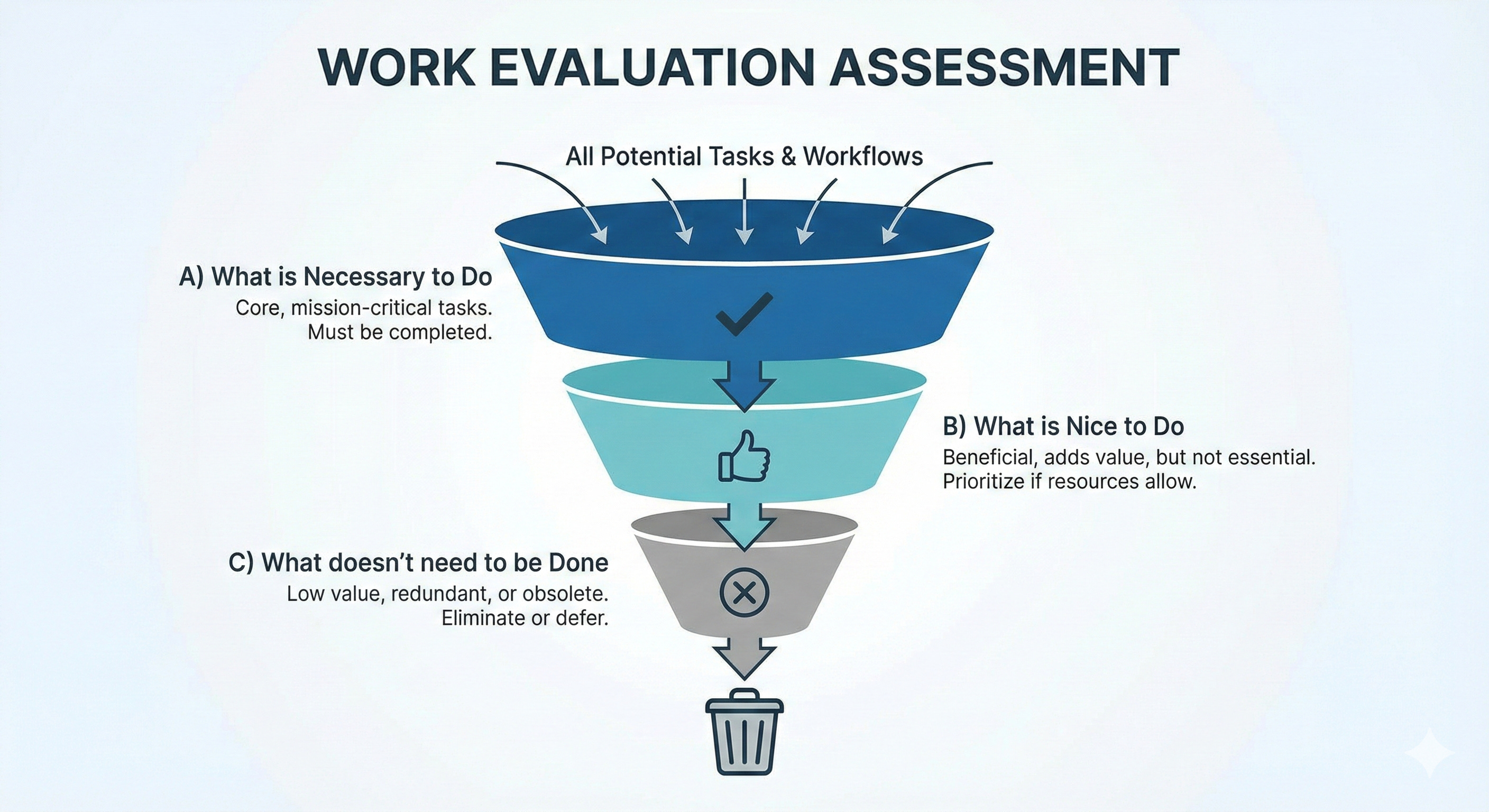
In each workshop, I do an exercise where I ask people to document the work that they are doing, organize it by some kind of theme/type, and then to map it to the specific objectives they are working on. After they write down that work, i have them then categorize those tasks and actions by
A) What is Necessary to Do
B) What is Nice to Do
C) What doesn’t need to be Done
You’d be surprised at how much work comes up in the “what doesn’t need to be done” bucket.
In each workshop I always ask participants to share with me one thing that they learned and want to apply in their work, and without fail, in every workshop at least 1-2 people say something to the effect of “I learned I’m doing a whole bunch of work that I do not need to be doing.
Having done this a lot, this is still funny but not surprising. Again, we often do work without really thinking about it, so when we actually have to think about the work we are doing, it often surfaces a lot of insights.
From there, once we have documented some of the work we can start to think more critically about the tasks, activities and workflows we have, where something like an AI tool (LLM, agent, assistant) could be valuable.
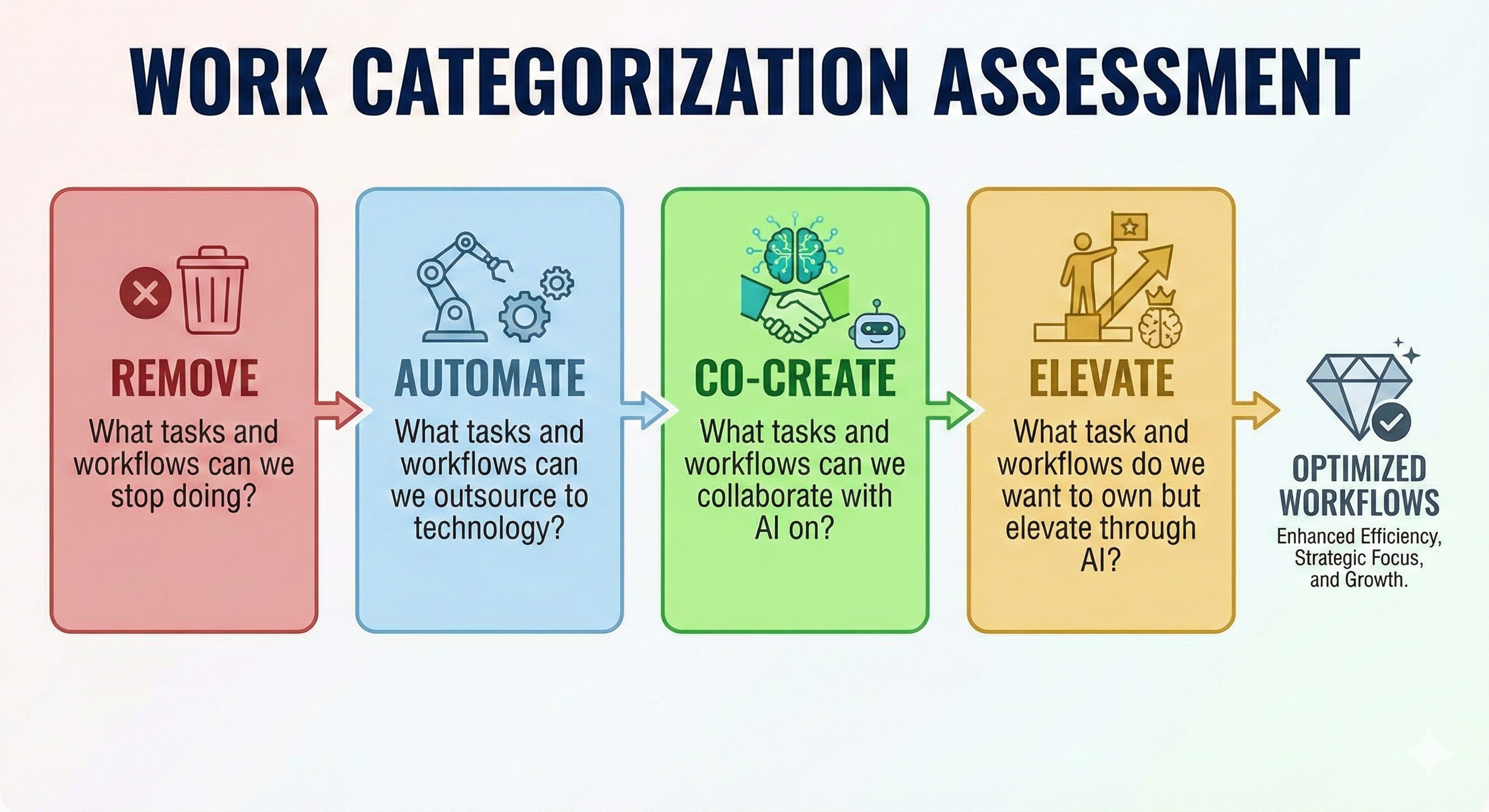
From that, I have an exercise where we go through the following questions/assessments:
Remove - What tasks and workflows can we stop doing?
Automate - What tasks and workflows can we outsource to technology?
Co-create - What tasks and workflows can we collaborate with AI on?
Elevate - What task and workflows do we want to own but elevate through AI?
I think of these as the four roles that we can use to reimagine our workflows with AI.
This exercise helps people see what’s possible in terms of the work that they are doing, what can be removed (frees up time) flat out automated by technology, co-created with AI, and then very creative work that we as humans want to mostly do, before we use AI to enhance it
Once we have that in place, then we can start to get into some of the AI tools (Co-Pilot, Chat GPT, etc) and use them based on the assessment we’ve made on the tasks/actions and activities for what we do
A couple key observations from running these exercises:
1. This is really an exercise to reimagine work
One of the more interesting findings from running about 25 of these is that as much as this is about using the tools themselves it really is about getting people to think more critically about the work that is worth doing. We tend to be very good at adding work and doing things but often don’t take the time to think about what is the work that is actually worth our time.
2. If you want to work differently you have to think differently
Learning how to use the tool is fine and good and important and has a place. But the real unlock is in getting people to think differently about their work, tasks, actions and activities. In my experience this is needed mostly because of how different these technologies are - simply doing the thing you are doing with the technology has some benefits, but the real opportunity with any technology that is transformative is in doing things you couldn’t do previously, or working in an entirely new way. The only way to do that is to start thinking differently
This is about change management to the nth degree
Many of the things we do at work are built upon decades of organizational processes and workflows - they don’t disappear overnight. This is as much a technical challenge as it really is a change management challenge.
People have lots of ideas about creative work
I find that asking people how they can incorporate AI in their work is a mixed bag. Some people get it, others really don’t. That said, if you ask people what’s wrong about their work, what’s broken, what annoys them, or what they wish they could do, they have lots of ideas and thoughts!
I actually think both matter, but I think you have to ask the latter set of questions before you get to the former ones. This is also a reminder that a lot of times, the people who know the problems that need to be solved or ideas for novel solutions are often closest to your customers. It’s worth empowering them
Conclusion
I know we are at the beginning of the journey with how most of us in knowledge work environments are using AI in our day to day work. But before we get too far in, I think it’s worth reminding ourselves and reflecting on what we’re actually doing here and trying to achieve.
We don’t do things for the sake of doing them and we wouldn’t implement or make a change to a technology without actually making sure we are reimagining what we do to work in a new way (or else we should have just stayed with what we had) but too often it’s easy to get lost in the sauce and focused solely on the stated objective (use AI) versus actually trying to achieve a specific outcome.
How I Can Help Your Organization
Thanks for reading! If you enjoyed this newsletter and found it valuable and would like to work together, here are three ways. If you’re looking for some help for your learning and development, leadership development, I’d love to work with you: Here is how I might be able to assist:
Leadership & Learning Programs: Formal training and leadership development in your company, such as new manager or new leader training, or skill-based programs. (See Here for more details)
Keynote Speaking - Do you have a conference, offsite, or event and in need of a speaker on topics including leading change, influencing others, or human skills for an AI world? I’d love to hear more and see how I can assist
Advising and Consulting - Do you need guidance around a strategy or roadmap for navigating talent or learning strategy? Let’s Chat
Feel free to contact me directly for more details!
Great article Al!
What sits underneath your workshops is something deeper than enablement: AI is exposing how much work exists to avoid judgment.
When execution becomes cheap, the real question shifts from how do we do this faster to should this exist at all. That’s uncomfortable, because stopping work threatens identity, status, and perceived value far more than learning a new tool.
Your move from tool-first to context-first isn’t about better adoption, it’s about withdrawing legitimacy from obsolete work. That’s why the “remove” category is so revealing, and so hard.
The real constraint isn’t AI literacy. It’s giving people permission to let go of work that once signaled usefulness, but no longer creates value.